
The Hive AI

AI The Hive / ResearchInvestigación / CAMBRICA

RunningEn marcha

CAMBRICA

Can a neural network learn language without gradients?

¿Puede una red neuronal aprender lenguaje sin gradientes?

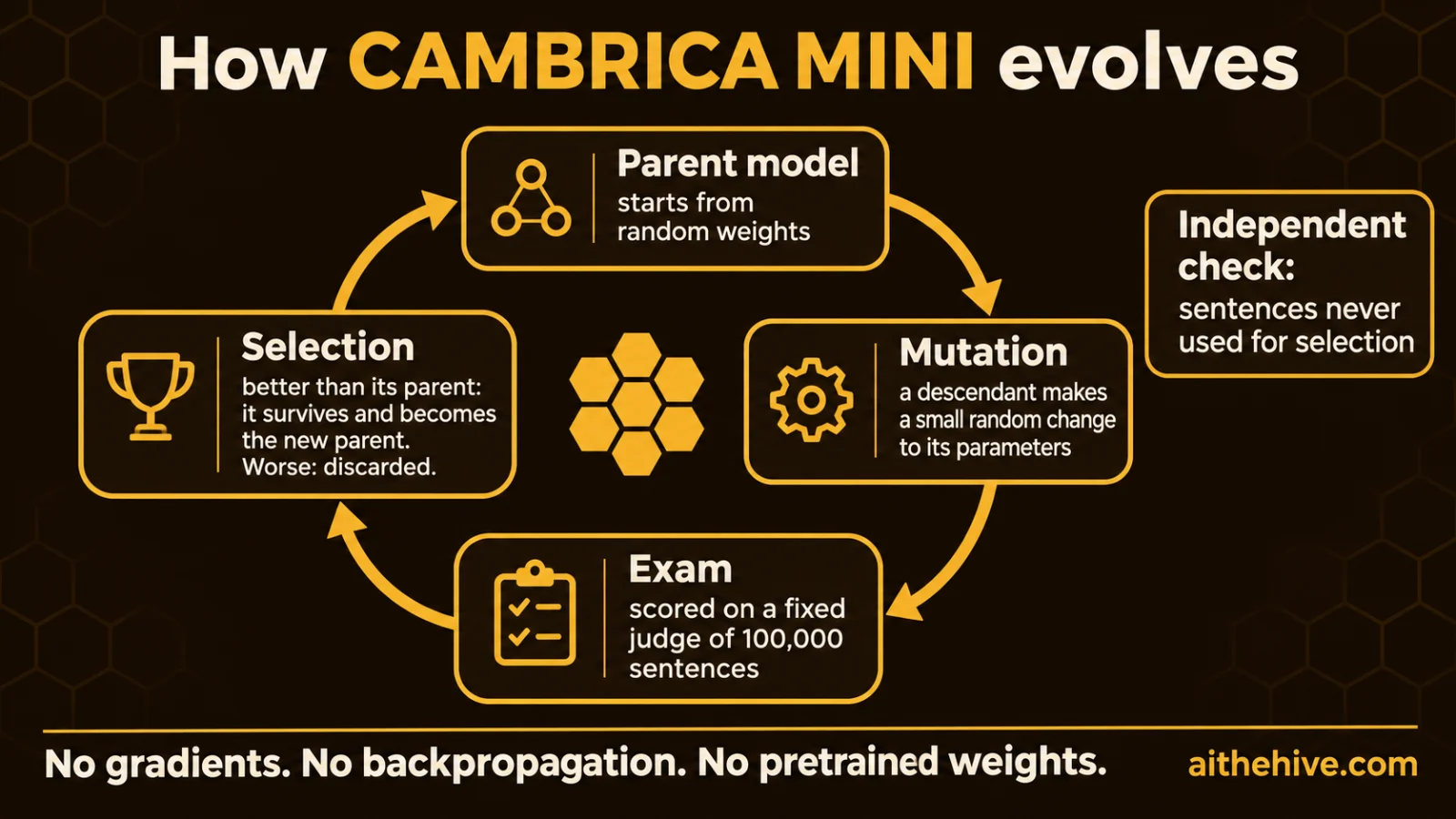
No gradients and no backpropagation. The weights are born at random, and they change only by trying modifications and keeping the ones that improve. No weights from any trained model are used. The goal is a much simpler and cheaper way to train a model; randomness is the tool, not the point.

Sin gradientes ni retropropagación. Los pesos nacen al azar y solo cambian probando modificaciones y quedándose con las que mejoran. No se usan pesos de ningún modelo entrenado. El objetivo es una forma mucho más sencilla y barata de entrenar un modelo; el azar es la herramienta, no la meta.

It isn't new in the world: Uber, OpenAI and Oxford have tried evolving weights. What's ours is the concrete path, the tests and the results, done with very little compute.

No es nuevo en el mundo: Uber, OpenAI y Oxford ya probaron a evolucionar pesos. Lo nuestro es el camino concreto, las pruebas y los resultados, hechos con muy poco cómputo.

Research update, 27 November 2026

Actualización científica, 27 de noviembre de 2026

CAMBRICA MINI keeps improving on sentences it has never seen

CAMBRICA MINI sigue mejorando en frases que nunca ha visto

On the 100,000 held-out sentences, never used to select descendants, CAMBRICA MINI reached a perplexity of 692.51, measured over 539,074 predictions. The best model that only uses word frequencies, calculated from those same sentences, scores 875.06. Evolution alone is now 20.9% better. On 26 November it was 836.72, 4.38% better.

En las 100.000 frases reservadas, que nunca se usaron para elegir descendientes, CAMBRICA MINI ha llegado a una perplejidad de 692,51, medida sobre 539.074 predicciones. El mejor modelo que solo usa la frecuencia de las palabras, calculado sobre esas mismas frases, se queda en 875,06. Solo con evolución, ya es un 20,9 % mejor. El 26 de noviembre estaba en 836,72, un 4,38 % mejor.

Perplexity on 100,000 held-out sentences. Lower is better.Perplejidad en 100.000 frases reservadas. Cuanto más baja, mejor.
Word-frequency modelModelo de frecuencias875.06875,06
CAMBRICA MINI, 26 NovemberCAMBRICA MINI, 26 de noviembre836.72836,72
CAMBRICA MINI, 27 NovemberCAMBRICA MINI, 27 de noviembre692.51692,51
Improvement over word frequenciesMejora sobre las frecuencias20.9%20,9 %

Where CAMBRICA MINI is now

Dónde está ahora CAMBRICA MINI

Perplexity on the fixed judge of 100,000 sentences, on a log scale. Lower is better. The gold marker moves with the live reading.

Perplejidad en el juez fijo de 100.000 frases, en escala logarítmica. Cuanto más baja, mejor. El marcador dorado se mueve con la lectura en directo.
Why it matters

Por qué importa

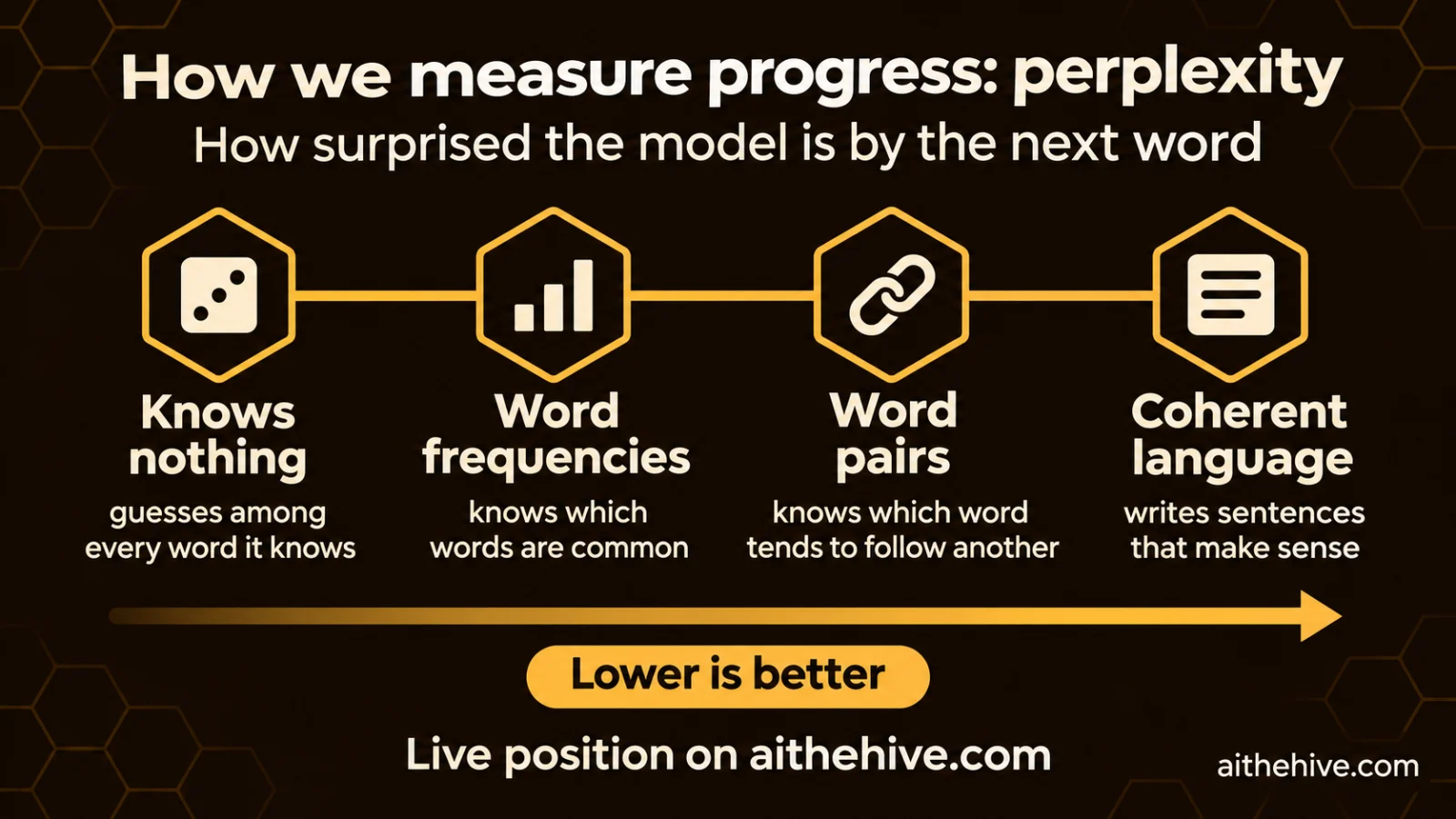
A model that only knows word frequencies gives every word the same probability, whatever came before. Beating it means CAMBRICA is using something more, such as word order. It does not show understanding or conversation yet, but frequencies alone no longer explain its results.

Un modelo que solo conoce frecuencias da a cada palabra la misma probabilidad, venga lo que venga antes. Superarlo significa que CAMBRICA aprovecha algo más, como el orden de las palabras. Todavía no demuestra comprensión ni capacidad de conversación, pero las frecuencias ya no bastan para explicar sus resultados.

How it evolves: DARWIN CMINI

Cómo evoluciona: DARWIN CMINI

CAMBRICA MINI is a two-layer Transformer with 1,542,784 parameters that started at random, and a 10,000-word vocabulary. Each descendant changes 100 parameters chosen at random, by different amounts and in either direction. It is scored on a fixed judge of 100,000 sentences; if it beats its parent, it survives and becomes the next parent.

CAMBRICA MINI es un Transformer de dos capas con 1.542.784 parámetros que partieron del azar y un vocabulario de 10.000 palabras. Cada descendiente cambia 100 parámetros elegidos al azar, con distintas magnitudes y signos. Se evalúa en un juez fijo de 100.000 frases; si supera a su padre, sobrevive y pasa a ser el siguiente padre.

Evolution has resumed from descendant 298,184, with exactly the same rules.

La evolución se ha reanudado desde el descendiente 298.184, con exactamente las mismas reglas.

A reference with gradients

Una referencia con gradientes

In a separate test, a copy of the model was trained the usual way, with gradients. After 100 passes and 4 minutes 41 seconds of GPU time it reached a perplexity of 106.18. That figure is on the sentences used to train that copy, not an independent measurement, and the test stopped at 100 passes. The evolving model was not touched.

En una prueba aparte, una copia del modelo se entrenó de la forma habitual, con gradientes. Tras 100 pasadas y 4 minutos y 41 segundos de GPU llegó a una perplejidad de 106,18. Esa cifra corresponde a las frases con las que se entrenó esa copia, no a una evaluación independiente, y la prueba se paró en 100 pasadas. El modelo que evoluciona no se tocó.

What comes next

Qué viene ahora

The next question is whether evolution can learn relationships between words, compete with models that use word pairs (bigrams) and, eventually, produce coherent language. We are not programming the path. We are watching which path evolution finds.

La siguiente pregunta es si la evolución puede aprender relaciones entre palabras, competir con modelos de pares de palabras (bigramas) y, con el tiempo, generar lenguaje coherente. No hemos programado el camino que debe seguir. Estamos observando qué camino encuentra la evolución.

The experiment keeps running, and we will publish the next result, good or bad. Follow the updates on X

El experimento sigue en marcha y publicaremos el próximo resultado, salga bien o mal. Sigue las novedades en X
Phase 1: 9 to 23 November

Fase 1: del 9 al 23 de noviembre

CAMBRICA 1.5B

150,000 → 1,259

150.000 → 1.259

perplexity on 3,000 blind sentences never used to learn

perplejidad en 3.000 frases ciegas que nunca se usan para aprender

1,543,714,304 random weights with Qwen 1.5B's architecture and vocabulary; 942,165 Spanish sentences from Tatoeba, subtitles and Wikipedia. It never produced coherent language.

1.543.714.304 pesos al azar con la arquitectura y el diccionario de Qwen 1.5B; 942.165 frases en español de Tatoeba, subtítulos y Wikipedia. No llegó a generar lenguaje coherente.

Measured: tiny changes don't break the model, and what improves on a fixed judge of 100,000 sentences improves the same on another 100,000 it never saw. The brake: blind shots that moved some 13,000 numbers at once broke things 9 times out of 10.

Medido: los cambios muy pequeños no rompen el modelo, y lo que mejora en un juez fijo de 100.000 frases mejora igual en otras 100.000 que no ha visto. El freno: disparos a ciegas de unos 13.000 números a la vez estropeaban 9 de cada 10 veces.

Yardstick: the same model, from random, trained with gradients on a $0.50-an-hour GPU, passed 1,259 in one minute and reached 48.5 in three hours. That isn't the goal; it's the reference.

Vara de medir: el mismo modelo, desde el azar, entrenado con gradientes en una tarjeta de 0,5 dólares la hora, pasó de 1.259 en un minuto y llegó a 48,5 en tres horas. No es el objetivo: es la referencia.

Phase 2: since 23 November

Fase 2: desde el 23 de noviembre

CAMBRICA MINI

692.51

692,51

perplexity on 100,000 sentences never used for selection, 20.9% below the best word-frequency model (875.06)

perplejidad en 100.000 frases que nunca se usaron para elegir, un 20,9 % por debajo del mejor modelo de frecuencias (875,06)

A thousand times smaller: 1,542,784 random weights, a 2-layer Transformer with its own 10,000-word vocabulary from Tatoeba.

Mil veces menor: 1.542.784 pesos al azar, un Transformer de 2 capas con vocabulario propio de 10.000 palabras de Tatoeba.

It started by multiplying blocks of weights by 1.01 or 0.99 and keeping each change only if it beat the parent on the judge. From a perplexity of 1,742.30 it evolves with DARWIN CMINI: each descendant changes 100 parameters chosen at random.

Empezó multiplicando bloques de pesos por 1,01 o por 0,99 y conservando cada cambio solo si superaba al padre en el juez. Desde una perplejidad de 1.742,30 evoluciona con DARWIN CMINI: cada descendiente cambia 100 parámetros elegidos al azar.

Shown so far

Demostrado

  • A network that starts from random improves by selecting changes to its weights, without gradients.
  • Una red que parte del azar mejora seleccionando cambios en sus pesos, sin gradientes.
  • That improvement holds on sentences it has never seen.
  • Esa mejora se mantiene en frases que no ha visto.
  • It beats the best word-frequency model on 100,000 sentences it never saw: 692.51 against 875.06 on 27 November, 20.9% better.
  • Supera al mejor modelo de frecuencias en 100.000 frases que no ha visto: 692,51 frente a 875,06 el 27 de noviembre, un 20,9 % mejor.

Not shown yet

Todavía no demostrado

  • That it beats models that use word pairs (bigrams).
  • Que supere a los modelos de pares de palabras (bigramas).
  • That it writes coherent language.
  • Que genere lenguaje coherente.
  • That it can compete with normal training. A copy trained with gradients reached 106.18 in under five minutes, measured on its own training sentences.
  • Que compita con el entrenamiento normal. Una copia entrenada con gradientes llegó a 106,18 en menos de cinco minutos, medido en sus propias frases de entrenamiento.

Experiment log

Bitácora del experimento

  • 692.51 on held-out sentences. On the 100,000 sentences never used for selection, measured over 539,074 predictions: 20.9% below the word-frequency model (875.06). Evolution kept running during the measurement.

    692,51 en frases reservadas. En las 100.000 frases que nunca se usaron para seleccionar, medido sobre 539.074 predicciones: un 20,9 % por debajo del modelo de frecuencias (875,06). La evolución siguió en marcha durante la medición.

  • The word-frequency barrier falls on unseen text. 836.72 against 875.06 on the held-out sentences, 4.38% better. Evolution resumed from descendant 298,184 with the same rules.

    Cae la barrera de las frecuencias en texto no visto. 836,72 frente a 875,06 en las frases reservadas, un 4,38 % mejor. La evolución se reanudó desde el descendiente 298.184 con las mismas reglas.

  • Below the frequency line on the judge. 863.69 against 872.66, with 259,762 descendants evaluated and 44,067 survivors.

    Por debajo de la línea de frecuencias en el juez. 863,69 frente a 872,66, con 259.762 descendientes evaluados y 44.067 supervivientes.

  • Below 1,000. 986.12 on the judge, 79.3% lower than the 4,755 of 24 November. The live readings start on this site.

    Por debajo de 1.000. 986,12 en el juez, un 79,3 % menos que los 4.755 del 24 de noviembre. Empiezan las lecturas en directo en esta web.

  • 4,755 with 400 blocks. Phase 2 keeps improving by scaling blocks of weights. Later, from 1,742.30, DARWIN CMINI takes over.

    4.755 con 400 bloques. La fase 2 sigue mejorando escalando bloques de pesos. Después, desde 1.742,30, toma el relevo DARWIN CMINI.

  • Phase 2 starts: CAMBRICA MINI. A thousand times smaller than Phase 1: 1,542,784 random weights and its own 10,000-word vocabulary.

    Empieza la fase 2: CAMBRICA MINI. Mil veces menor que la fase 1: 1.542.784 pesos al azar y vocabulario propio de 10.000 palabras.

  • Phase 1: CAMBRICA 1.5B. From 150,000 to 1,259 perplexity on blind sentences with 1.5 billion random weights. It never produced coherent language.

    Fase 1: CAMBRICA 1.5B. De 150.000 a 1.259 de perplejidad en frases ciegas con 1.500 millones de pesos al azar. No llegó a generar lenguaje coherente.

Join this research

Únete a esta investigación

Researchers, developers, companies or simply curious people: tell us how you would like to take part in CAMBRICA and we will reply by email.

Investigadores, programadores, empresas o simplemente curiosos: cuéntanos cómo quieres participar en CAMBRICA y te contestamos por correo.